The Pomodoro Technique

Francesco Cirillo was a university student in Rome in the late 1980s, struggling — like most students — to keep his attention from wandering. His solution was deceptively simple: he picked up a kitchen timer shaped like a tomato, set it for 25 minutes, and committed to doing nothing but work until it rang. The Italian word for tomato is pomodoro. The rest, as they say, is productivity history.
Today the Pomodoro Technique is one of the most widely adopted time-management frameworks in the world. It is taught in universities, recommended by psychologists managing occupational stress, and embraced by software engineers, writers, students, and executives alike. Its enduring appeal lies in a simple truth: our brains are not built for marathon, uninterrupted concentration. They are built for bursts.
The core method
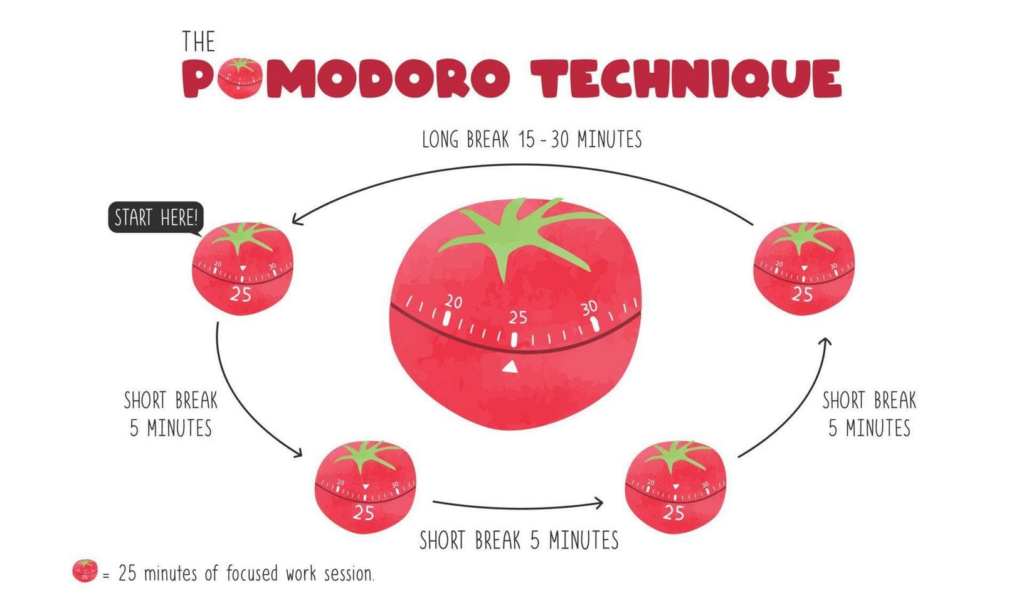
The technique is built around a repeating cycle. There are no apps, subscriptions, or complex systems required — just a timer and a commitment to the intervals.
Critically, each 25-minute block is considered a single, indivisible unit. If an interruption arises — a colleague stops by, a notification pings — you either defer it and continue, or abandon the pomodoro and restart. This all-or-nothing framing is intentional: it trains you to protect your attention as a finite resource, not a background process that can be paused and resumed without cost.
Why 25 minutes? The neuroscience of attention
The 25-minute interval was arrived at empirically by Cirillo through personal experimentation, but it aligns remarkably well with what contemporary cognitive science has since documented about sustained attention and mental fatigue.
Research published in the journal Cognition by Atsunori Ariga and Alejandro Lleras at the University of Illinois found that brief mental breaks help maintain consistent focus over prolonged tasks. The study showed that participants who took brief diversions performed significantly better on sustained attention tasks than those who worked without any pause. The finding challenges the intuitive assumption that stopping work, however briefly, is a productivity cost. In fact, the opposite is true: without breaks, the brain’s attentional resources deplete, and performance quietly degrades — often without the individual noticing.
This phenomenon connects to a broader concept in cognitive psychology: directed attention fatigue, first described by Rachel and Stephen Kaplan. When we engage in voluntary, directed focus — the kind required for writing, coding, or analysis — we draw on a limited reservoir of executive function. Short breaks allow partial recovery of those resources, making the next sprint of work more effective than if we had pushed through.
“The ability to focus is like a muscle — it strengthens with practice and fatigues with overuse. The Pomodoro method is, in essence, interval training for the mind.”
The hidden benefits: beyond just “getting things done”
The Pomodoro Technique does more than batch your work into manageable chunks. Several of its secondary effects are what make practitioners loyal to it over the long term.
It makes time visible. Most people have a vague, imprecise relationship with how long tasks actually take. Tracking completed pomodoros over days and weeks creates a concrete record — a kind of personal time log — that dramatically improves future planning. Cirillo’s original method includes a to-do sheet where completed pomodoros are marked with an “X,” building an honest picture of your output capacity.
It reduces the weight of starting. A psychological barrier to beginning difficult work is the perception of its scale. Committing to “write a chapter” feels daunting; committing to “work on this for the next 25 minutes” is approachable. The Zeigarnik effect — the brain’s tendency to more easily continue tasks that are in progress than to start new ones — means that once a pomodoro begins, momentum tends to carry the work forward.
It creates natural accountability. The timer acts as an external commitment device. Behavioural economists have long noted that human beings respond well to concrete, time-bound constraints. The ticking clock introduces a mild, productive urgency that is distinct from anxiety — it is the same dynamic that makes deadlines effective, compressed into a 25-minute frame.
It combats perfectionism and procrastination. When you know you only have to endure 25 minutes, the stakes of any given session feel lower. Perfectionist paralysis — the tendency to not start because the work might not be good enough — weakens when the commitment is explicitly temporary. You are not writing the whole report; you are just writing for 25 minutes.
Handling interruptions: the core discipline
Cirillo’s method distinguishes between two types of interruptions: internal (a stray thought, an urge to check your phone) and external (a colleague, an incoming call). The prescribed response to both is the same: note it, don’t act on it, return to the task.
For internal interruptions, the method uses what Cirillo calls the “inform, negotiate, call back” strategy for external ones: you briefly acknowledge the interruption, propose a specific time to address it, and protect the current pomodoro. Over time, this practice builds a kind of social and psychological boundary around focused work that many practitioners find transforms their relationship with constant connectivity.
Research on the cost of interruptions supports the value of this discipline. A study by Gloria Mark at the University of California, Irvine, cited widely in Harvard Business Review, found that it takes an average of over 20 minutes to fully return to a task after an interruption. Within a 25-minute pomodoro, that cost is existential — which is precisely why the method insists on protecting the interval.
Adapting the technique to your work
Purists use exactly 25 minutes. But many practitioners adjust the intervals to suit the nature of their work. Deep creative or analytical work sometimes benefits from extended sessions of 45 or 50 minutes, with proportionally longer breaks. Physical or high-stakes tasks may call for shorter intervals. The key principle — structured alternation between focused effort and deliberate rest — is what matters, not the specific duration. The Pomodoro Technique book by Cirillo discusses these variations in depth.
What the method is not is a rigid, militaristic schedule. Cirillo himself describes it as a framework for developing a healthier relationship with time — one built on awareness, estimation, and respect for the brain’s natural rhythms. The point is not to squeeze more hours of output from a working day but to make the hours you do work more honest, more present, and ultimately more sustainable.
Getting started
The barrier to entry is essentially zero. You need no special tools — a phone timer works perfectly — though dedicated apps like Focus Flow, Tomato Timer, or the desktop app Focusplan can add structure. Write down the task you intend to work on. Set the timer. Begin.
The first thing most new practitioners notice is how rarely they have previously given any task 25 minutes of their full, undivided attention. That noticing is itself the technique working.